
How to Choose the Right Digital Marketing Agency for Your Small Business
Sep 04, 2026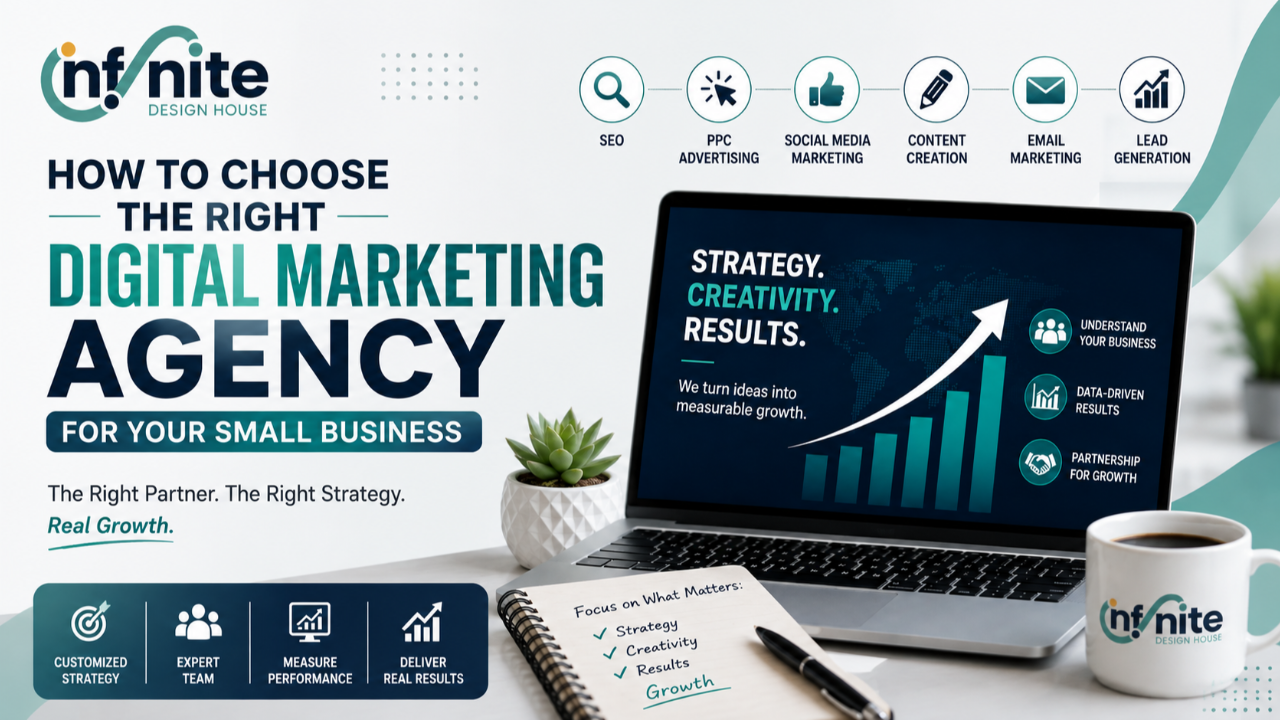
A practical guide to finding an agency that focuses on strategy, results, and growth
Quick takeaway: Choose an agency that understands your business, your customers, and your goals—and can clearly explain how its strategy will contribute to growth.
Choosing the right digital marketing agency for your small business can be one of the most important marketing decisions you make. The right agency can help you generate qualified leads, increase sales, improve your online presence, and build a predictable customer acquisition system.
But with so many agencies offering SEO, PPC, social media marketing, content marketing, web design, email marketing, and lead generation, how do you know which one is actually right for your business?
The answer isn't to choose the agency with the longest list of services. Choose the one that understands your business, your customers, and your goals—and can clearly explain how its strategy will contribute to growth.
What Should You Look for in a Digital Marketing Agency?
Before comparing agencies, first determine what you actually need marketing to accomplish.
- Generate more qualified leads
- Increase sales and revenue
- Reduce customer acquisition costs
- Improve website conversion rates
- Increase memberships or enrollment
- Enter a new market
- Strengthen your brand positioning
- Build a stronger online presence
These goals are more important than simply increasing website traffic, followers, clicks, or impressions. Marketing activity doesn't automatically equal business growth. You can have thousands of website visitors or hundreds of leads without generating more customers.
That's why you shouldn't choose an agency based only on what it promises to do. Choose one that can explain why it recommends a particular strategy, how success will be measured, and how the work connects to your business goals.
Make Sure the Agency Understands Your Target Customer
Successful digital marketing starts with understanding the customer.
Before discussing Google, Facebook, LinkedIn, SEO, or email, your agency should understand:
- Who your ideal customer is
- What problem they are trying to solve
- What motivates them to buy
- What objections they have
- How they research solutions
- Why they choose one company over another
- What messaging is most likely to resonate
If an agency can't clearly explain your target customer, it's difficult to trust its marketing strategy. Adding more channels won't solve an audience problem. It may simply mean you're reaching the wrong people in more places.
Focus on Business Metrics, Not Vanity Metrics
Traffic, impressions, clicks, followers, and engagement can all be useful. But they're usually indicators—not the final business outcome.
Marketing Spend → Qualified Leads → Customers → Revenue → ROI
Ask: “Which business outcomes will you be accountable for?” If the answer focuses only on rankings, traffic, impressions, clicks, or engagement, keep asking questions.
A good digital marketing strategy should ultimately help you understand whether your marketing investment is contributing to business growth.
Ask How the Agency Tracks Leads and Revenue
Lead generation is only one part of the customer acquisition process. Suppose an agency generates 100 leads. What happens next?
- Are those leads sent to your sales team?
- Added to your CRM?
- Qualified?
- Contacted quickly?
- Put into a nurturing sequence?
- Tracked through the sales process?
- Connected back to the original marketing campaign?
A serious digital marketing agency should consider the entire customer journey. This may include website conversion tracking, advertising tracking, CRM integration, call tracking, form tracking, lead attribution, marketing automation, email nurturing, and revenue attribution.
Generating a lead isn't the same as generating a customer.
Look for Relevant Experience
A large portfolio can be impressive, but more clients don't necessarily mean better results for your business.
Instead of simply asking, “Who are your clients?” ask: “What problem did you solve for them, and what changed as a result?”
Look for agencies that have experience solving challenges similar to yours. Industry specialization can be valuable, but it isn't always essential. What's more important is whether the agency understands your audience, buying process, competition, and business model.
Relevant experience is more valuable than a long list of logos.
Find Out Who Will Actually Work on Your Account
The person who presents your marketing strategy may not be the person who delivers it.
Before signing a contract, ask:
- Who will be my day-to-day contact?
- Who develops the strategy?
- Who manages advertising and SEO?
- Who creates content?
- Who handles analytics?
- Who prepares reports?
- Are the team members employees or contractors?
- How experienced is the team?
You want to know exactly who you're hiring. Don't buy senior-level expertise during the sales process only to receive a completely different level of service after signing the contract.
Compare Digital Marketing Agency Pricing Carefully
Price matters, but it shouldn't be the only factor.
A $1,000-per-month agency that produces little value isn't necessarily cheaper than a $3,000-per-month agency that consistently generates profitable business. You're comparing economics, not just monthly fees.
When comparing digital marketing agency pricing, consider:
- Monthly management fees
- Advertising spend
- Setup fees
- Website costs
- Content and creative costs
- Software costs
- Contract length
- Cancellation terms
- Additional fees
- Reporting and account management
Also clarify ownership. Who owns your website, advertising accounts, creative assets, customer data, analytics, and tracking systems if you stop working together?
Be Careful With Agencies That Guarantee Results
One of the biggest red flags is an agency making unrealistic guarantees. Marketing involves too many variables for an agency to control everything. A credible agency should provide realistic expectations, including what it expects, why it expects it, the assumptions behind the strategy, the expected timeframe, and what it will change if results don't meet expectations.
Confidence is good. Unrealistic certainty isn't.
Avoid One-Size-Fits-All Marketing Strategies
Your business isn't the same as another agency's client. Your customers, sales cycle, competition, budget, margins, and goals may all be different. Your digital marketing strategy should be different too.
If every proposal includes the same combination of SEO, PPC, social media, content, and email marketing, ask whether the agency is actually solving your problem—or simply selling a package.
A good agency should explain what it recommends, what it doesn't recommend, and why.
So, How Do You Choose the Right Digital Marketing Agency?
Choosing the right agency becomes easier when you follow a simple process:
- Define the business problem. Know what you're trying to improve.
- Give several agencies the same information. This makes comparisons fair.
- Ask for a strategy—not just a service list.
- Challenge the reasoning. Ask why each major activity is being recommended.
- Examine how results will be measured. Make sure marketing connects to business outcomes.
- Evaluate the actual team. Know who will do the work.
- Compare pricing and contracts. Understand fees, ownership, cancellation terms, and additional costs.
- Score agencies objectively. Use a scorecard instead of choosing based on personality alone.
- Look for realistic expectations. A good agency should be confident without pretending it can control everything.
- Choose the agency that understands your business.
It doesn't necessarily need to be the biggest agency, the cheapest agency, or the one with the largest portfolio.
Final Thoughts: Choose Growth Over Marketing Activity
More posts don't automatically mean more customers. More traffic doesn't automatically mean more revenue. More leads don't automatically mean more sales. More marketing activity doesn't automatically mean more growth.
Marketing works when it is connected to a real business objective.
Instead of asking: “What digital marketing services do you offer?”
Ask: “What business problem are you solving, why are you solving it this way, and how will we know you've solved it?”
The answer can tell you more about a digital marketing agency than its service menu ever will.
You're not hiring an agency to make your business look like it's marketing. You're hiring one to help your business grow.
Need help getting started? Contact us today to discuss your marketing.


